BUYING GUIDES
How to choose a cutting board for an RV or camper kitchen
Choose a cutting board for an rv or camper kitchen that fits tight counters, stores safely, and cleans up easily.
The short answer
A good cutting board for an rv or camper kitchen fits your actual counter and storage, not an idealized kitchen. Measure first, then weigh work area, weight, stability, and cleanup against the space you have.
- Measure the counter and storage before choosing a board.
- Pick a useful size that you can lift, wash, and stow.
- Compare materials and thickness with your knives and care routine in mind.
- Treat grooves, grips, and nonslip features as practical trade-offs, not necessities.
- Secure the board before driving and dry it fully before storage.
How do you measure your prep space and storage?
Measure the places where you prep and put things away before shopping. A board that fits the counter but blocks the sink or has nowhere to go afterward is not a space-saver. In an RV, a few inches can change how easily you cook.
Check counter space around the sink and stove
Measure the usable counter between the sink, stove, and any fixed edges, then consider what must remain accessible while you cook. A board should sit flat without covering a control or creating a cramped gap beside a hot burner. If you are considering a board that spans the sink, measure the rim and check that the board can rest securely rather than teetering across it. The small-kitchen sizing and storage guide for maple boards has more ideas for working with tight counters.
Measure cabinets, drawers, and other storage spots
Check the height, width, and depth of the cabinet or drawer where the board will live, including any lip that narrows the opening. Remember to account for its thickness and any feet, which can keep a board from sliding into a shallow drawer. A quick paper template can help you test the footprint in a storage spot and on the counter before you commit.
For a simple check, measure these spaces before you compare boards:
- The clear cutting area beside the sink and stove.
- The inside dimensions of the intended drawer or cabinet.
- The opening through which you need to carry the board.
- Any space where the board might be stored upright.
Those measurements tell you whether a board will fit through the whole routine, from meal prep to cleanup and storage. It is also worth measuring with cabinet doors open; a board that fits on paper may be awkward to remove in a tight aisle.
Leave room to set down ingredients and move safely
A board should leave you enough room to set down a bowl or plate without balancing it on the edge of the sink. Think about where chopped ingredients will go and whether another person needs to pass behind you. A slightly smaller board may be the better choice if it lets you keep a clear path and reach the faucet or stove without stretching.
What size and weight work on the road?
Choose the largest board that fits your counter and storage without becoming a chore to move. More surface area is useful for chopping, but a heavy board can be a poor match for a small sink or narrow cabinet. The right size is the one you can use and put away comfortably.
Balance a useful cutting area with easy storage
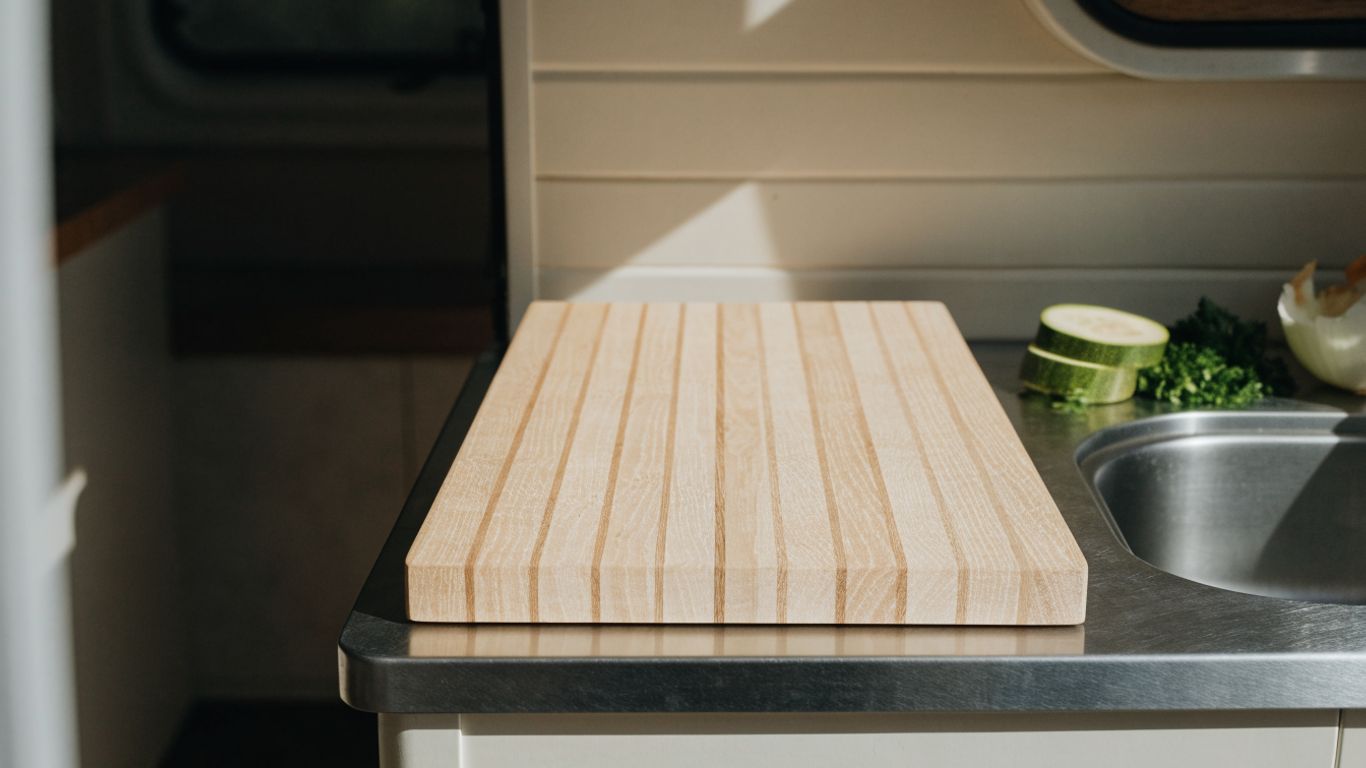
A board needs enough room for the food you usually prepare, plus a little space to gather chopped ingredients. If most of your meals involve a few vegetables or sandwiches, a compact board may be enough; bigger batches need more working area. As one concrete size reference, the Bevel & Bond End-Grain Maple Cutting Board measures 17 by 13 by 1.75 inches and weighs about 10 pounds. Those dimensions may be useful to compare against your own space, but they will not suit every camper. For more sizing considerations, see this guide to choosing a maple cutting board size.
Consider whether you’ll carry the board outside
If you prep at a picnic table or bring food outside, consider the distance, the board’s weight, and how easily you can carry it alongside ingredients. A compact, lighter board is usually easier to transport, though you give up some cutting area. Think through where it will land outdoors, too: a board set on an uneven surface can shift while you work. This guide to ultra-light boards for camping offers another perspective on portability.
Make sure the board is manageable to wash and put away
The board has to fit in your sink or be easy to wash with a cloth and the water available to you. A wide board may be comfortable to chop on but difficult to turn under a small faucet. The Bevel & Bond End-Grain Maple Cutting Board is about 10 pounds, a useful reminder to check the weight specification rather than judging a board by its listed dimensions alone. Choose a weight you can lift, rinse, dry, and store without wrestling it over the sink.
How do materials and construction compare?
For a road kitchen, prioritize a surface that suits your knives and a care routine you can keep up with. Wood and plastic can both work, but their feel, weight, and washing instructions differ. Thickness and construction also affect whether the board is practical to lift and stow.
Weigh wood’s knife-friendly feel against plastic’s lighter weight
Wood often feels gentler under a knife, while plastic boards are commonly lighter and may be easier to fit into a limited wash-up routine. Check the maker’s care directions rather than assuming every board can go in a dishwasher. Bamboo is another option, but its feel and construction vary by board. This maple and plastic board comparison can help you think through the trade-offs without treating one material as right for every kitchen.
A quick comparison helps clarify what matters most in a compact setup:
| Material | Possible advantage | Check before choosing |
|---|---|---|
| Wood | A solid, knife-friendly feel | Hand-washing and drying routine |
| Plastic | Often lighter and easy to handle | Care instructions and surface condition |
| Bamboo | A firm surface in many compact designs | Construction, weight, and maker’s care advice |
The table is a starting point, not a substitute for checking the specific board. If low weight matters most, compare actual weights; if knife feel matters more, consider what you are comfortable cutting on every day.
Consider how thickness affects weight and storage
Thickness affects both how substantial a board feels and how much room it takes in a drawer. A thicker board may be harder to lift and less likely to fit in a shallow slot, while a very thin one can feel less steady on a small counter. Check the listed thickness alongside weight, and measure the storage opening rather than guessing. The goal is a board that does not dominate the cabinet or make routine prep feel awkward.
Check that the surface is food-safe and built for regular use
Look for clear information about the material and finish, along with care instructions for regular food preparation. For wood, the finish should be intended for food-contact use; avoid guessing from a glossy appearance alone. Inspect the surface for cracks, loose joints, or rough spots that could make cleaning harder. A wood-finish guide explains what to look for when a maker describes a finish as food-safe.
Which features suit a compact kitchen?
Useful features should solve a real problem in your kitchen without taking away too much working area. Grooves, grips, and reversible surfaces can make a board more convenient, but they also affect its footprint and handling. Pick only what helps with the way you cook.
Use a juice groove for juicy foods without losing prep space
A groove can catch some liquid from sliced fruit or cooked meat, but it takes up part of the board’s surface and adds a channel to clean. Look at the flat area inside the groove, not just the outside dimensions, so you know how much room remains for cutting. The Bevel & Bond End-Grain Maple Cutting Board has a juice groove; if you are comparing boards with this feature, consider whether the containment is worth the reduced usable area in your camper.
Choose handles or cutouts that make the board easier to move
A handle or finger cutout can make lifting a board easier, especially when you need to move it from counter to sink. But those features may reduce the usable edge or affect how a board fits in a narrow drawer. Check where the grip sits and whether it helps you lift the board securely with wet hands. A feature is only useful if it makes the daily routine simpler.
Consider a reversible design for extra working area
A reversible board can give you two usable faces, though you will need to keep track of which side is appropriate for each task and clean both when needed. Make sure the edges are easy to grasp and the board can be turned without knocking into the faucet or stove. In a small kitchen, a second working surface can be handy, but a board that is awkward to flip may not earn its storage space.
How do you keep the board stable and secure?
A stable board matters more than a fancy feature when you are chopping in a compact kitchen. Start with a flat counter and a board that does not rock, then add a nonslip layer if needed. On the road, storage matters too: a loose board can slide or fall when the vehicle moves.
Look for nonslip feet or use a damp towel underneath
Nonslip feet can help hold a board in place, though they also add height and may affect drawer fit. If your board has no feet, place a slightly damp towel beneath it to reduce movement while you work. The Bevel & Bond End-Grain Maple Cutting Board has non-slip feet, a documented feature worth comparing with your own counter and storage setup. Whatever you choose, test the board with gentle pressure before using a knife.
Avoid cutting on an uneven or crowded counter
A board should sit flat, with enough clear space around it to keep ingredients and tools from being pushed off the edge. Move clutter before you start, and do not use a board that rocks over a sink or stove opening. If your usual work surface is uneven, find a more stable spot rather than trying to hold the board steady with one hand while cutting with the other.
Stow the board securely before driving
Before you travel, place the board in a drawer, cabinet, or other storage spot where it cannot slide out or fall. If it must stand upright, make sure it is held in place and cannot tip when a cabinet opens. A board that fits tightly enough to stay put is more useful than one that rattles around beside cookware. For broader tips on prepping in an outdoor kitchen, consider how the same board will be used beyond the camper.
How should you plan for cleaning and upkeep?
Choose a board whose care instructions fit your water supply and routine. In a camper, sink space may be limited, so a board that is easy to wash and dry is more practical than one that needs special handling you cannot manage. Whatever the material, clean it after use and store it dry.
Choose a board you can wash with the water you have
Check whether you can rinse or wipe the whole surface in your sink, including the edges and any grooves. For a wood board, follow the maker’s directions; a typical care routine is hand washing with mild soap and warm water, never soaking it, and avoiding the dishwasher. If the board is used for raw meat, clean it thoroughly before using it for other food, and consider a separate board for different tasks.
Dry it fully before storing it in a cabinet
After washing, dry the board and let it finish drying upright where air can reach both sides. Putting a damp board into a closed cabinet can trap moisture against the surface. In a small camper kitchen, you may need to plan a temporary drying spot near the sink; a minute of planning is easier than trying to wedge a wet board into a drawer.
Follow care instructions to help prevent odors, stains, and warping
Use the care directions for the exact material and finish, and avoid leaving food or liquid on the board for long stretches. For wood, routine hand washing and thorough drying help limit moisture problems; occasional conditioning with food-grade mineral oil may also be recommended by the maker. Do not use cooking oils such as olive or vegetable oil for conditioning. A little regular care is easier to fit into travel than trying to correct a neglected board later.
Choosing a cutting board for an RV or camper kitchen
The best board for your RV or camper is the one that fits your counter, stores securely, and feels manageable to wash and carry. Measure the whole routine, from the first cut to the drive-ready cabinet, and choose materials and features that make that routine easier rather than more complicated.
Best for
- Wood: cooks who want a solid, knife-friendly feel and can keep up with hand washing and drying.
- Plastic: RVers who want a lighter board that is easy to handle.
- Bamboo: compact kitchens where a firm surface suits you; check its weight and the maker's care advice.
Frequently Asked Questions
What size cutting board works best in an RV?
Measure your usable counter and storage first, then choose the largest board that fits both comfortably. Leave room for the sink, stove, ingredients, and safe movement.
Is a wood or plastic board better for a camper kitchen?
Either can work. Wood may feel more comfortable under a knife, while plastic is often lighter; compare the specific board’s weight and care instructions with your needs.
Can I use a cutting board over an RV sink?
You can if it rests securely across the sink and does not rock or shift. Measure the sink edges and check that the board stays level before cutting.
Should an RV cutting board have a juice groove?
A groove can catch some liquid, but it reduces the flat cutting area and takes extra cleaning. Choose one if that trade-off suits the foods you prepare.
How do I keep a cutting board from sliding while I chop?
Use a flat, uncluttered counter. If the board lacks nonslip feet, place a slightly damp towel underneath and check that it stays still before cutting.
How should I store a cutting board while driving?
Stow it in a drawer or cabinet where it cannot slide, fall, or shift into cookware. If it stands upright, secure it so it cannot tip when the cabinet opens.
How do I clean a wooden cutting board while camping?
Follow the maker’s directions. A common routine is to hand wash with mild soap and warm water, avoid soaking or dishwashing, and dry the board fully before storing it.
What should you do next?
- Measure the counter and the cabinet where the board will ride.
- Choose a size you can lift, wash, and stow.
- Compare materials and thickness with your knives and care routine in mind.
- Secure the board before driving, and dry it fully before storage.
- Read about cutting boards for a lake house or cabin kitchen and cutting boards for an outdoor kitchen.
SEE AN EXAMPLE